
Overview
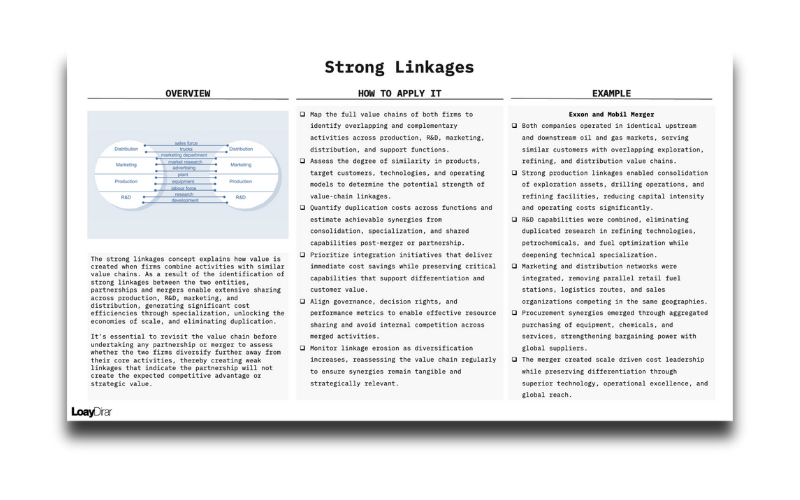
The Strong Linkages concept explains how value is created when organizations combine or coordinate activities with closely aligned value chains. When firms operate in similar markets with comparable products, customers, technologies, and operating models, their value chain activities overlap significantly. Strong linkages across production, R&D, marketing, and distribution enable resource sharing, specialization, and the elimination of duplication. This leads to cost efficiencies, economies of scale, and deeper expertise. As firms move further away from their core activities, these linkages weaken, reducing synergies and limiting value creation.
How to Use It
Apply the concept by mapping the full value chains of the firms involved and identifying areas of overlap and complementarity. Assess the strength of linkages across functions such as production, R&D, marketing, and distribution. Prioritize integration initiatives that unlock cost savings and capability enhancement, while continuously reassessing linkages as diversification increases to avoid value dilution.
Exxon Mobil Merger Example
The Exxon Mobil merger leveraged strong linkages across identical upstream and downstream value chains. By consolidating production, R&D, marketing, distribution, and procurement, the combined firm eliminated duplication, achieved economies of scale, reduced costs, and strengthened global cost leadership while maintaining technological and operational differentiation.
Strong Linkages